A First Principles Exploration
The Zero Cost
Question
An invitation to think together about what happens when intelligence becomes "too cheap to meter"—and whether it actually will.
The techno-optimist vision is seductive: AI inference costs following the trajectory of computing before it, declining exponentially until intelligence becomes essentially free. Sam Altman calls it "intelligence too cheap to meter." Peter Diamandis sees a world of radical abundance. Salim Ismail speaks of transformation at exponential speed.
But seductive visions deserve rigorous examination. Not to dismiss them—but to understand what they require, what they assume, and what questions their proponents should be prepared to answer.
Part I
The Economic Questions
The Elephant on the Lap
Every conversation about AI costs focuses on compute. But between that inference and your device lies infrastructure owned by someone: submarine cables, terrestrial fiber, cellular networks, last-mile connections. The transport layer—the elephant everyone ignores.
The Math So Far
Sources: Goldman Sachs AI Infrastructure Report 2025, Sequoia "AI's $600B Question"
"Our children will enjoy in their homes electrical energy too cheap to meter."
Historical Precedent — Nuclear Power, 1954
Questions We Should Be Asking
- →If inference costs drop 90%, who captures that value—users or platform owners?
- →What happens when telecom companies realize AI traffic is 10x regular data value?
- →Can Wright's Law apply to a sector with zero price competition pressure?
- →How do we get from $10 per million tokens to $0.001 when debt service payments come due?
Part II
The Human Question
The techno-optimist narrative assumes a simple progression: abundance arrives, humans adapt, everyone benefits. But this assumption contradicts the evidence we have about what happens when purpose disappears.
Russia, 1989-1995
When the Soviet Union collapsed, something unexpected happened. Material conditions didn't change much initially—the apartments, the infrastructure, the resources were still there. What collapsed was the framework of meaning.

The deaths weren't from starvation or exposure. They were deaths of despair— cardiovascular events, alcohol, suicide—concentrated among working-age men who suddenly had no framework for what their lives meant.
If abundance is coming, understanding what happened to Russia matters enormously. Not because abundance is bad—but because abundance without structure is lethal.
China, 1966-1976
The Cultural Revolution offers a different but equally instructive lesson. Millions of educated young people—the Red Guards—were given ideology but no productive purpose. They found meaning in destruction.
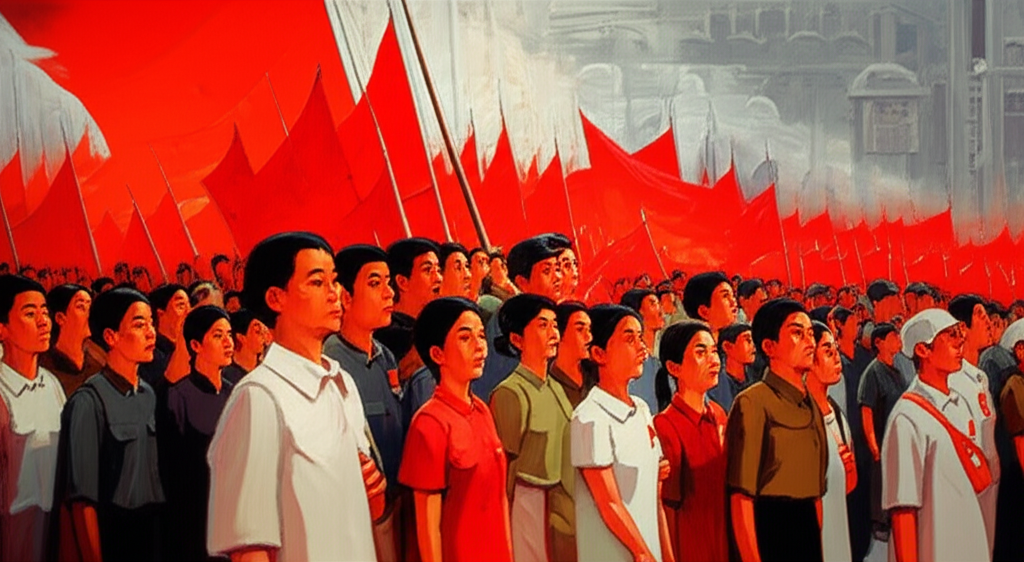
These weren't uneducated masses. They were students, intellectuals, young professionals—exactly the demographic that abundance theorists assume will thrive when freed from economic necessity. Instead, without structures that channeled their energy toward creation, they channeled it toward destruction.
The Red Guards weren't responding to scarcity. They were responding to a vacuum of meaning—and they filled it with the only purpose available: revolutionary violence against the "old world."
Russia shows what happens when meaning collapses inward—deaths of despair. China shows what happens when purposelessness finds an external target— destruction as meaning. Both warn us: abundance without structure isn't neutral.
The Pattern
Part III
The Cathedral Question
They weren't built by comfortable people
with nothing to do.
The medieval cathedrals represent something crucial: humans creating meaning through reaching toward something beyond survival. Not because they were bored, but because they needed to.
This is the question the abundance narrative never addresses: What do humans reach toward when survival is solved? The cathedrals weren't useful in any economic sense. They were necessary in a human sense.
There's a critical distinction: purpose toward something versus purposefor something. The techno-optimists imagine purpose emerging naturally from abundance—hobbies, creativity, exploration. But the evidence suggests purpose requires reaching beyond comfort, not settling into it.
The Question for the Moonshot Thinkers
If you're right about abundance, what are you building that gives people something to reach toward?
Not what will people do for fun. What will they sacrifice for?
Part IV
A Moonshot Hiding in Plain Sight
Device-Native Intelligence
There's an alternative path the current narrative largely ignores: intelligence that lives on your device, requires no cloud connection, pays no transport toll.
Apple has quietly been building toward this. Specialized neural engines. On-device processing. Privacy as a feature that's actually infrastructure independence.
This is the moonshot hiding in plain sight: democratized intelligence that genuinely can't be metered because it never leaves your device. The transport layer becomes irrelevant. The pricing power of infrastructure owners becomes moot.
The irony is that the path to "too cheap to meter" might run through devices, not data centers. Through distribution, not concentration. Through the very decentralization that the current investment thesis ignores.
An Invitation, Not a Rebuttal
We're not arguing against abundance. We're asking what it actually requires— economically, infrastructurally, humanly. The best moonshot thinkers should welcome these questions. The vision becomes stronger when it can address them.
The cathedral builders didn't need someone to tell them what to build.
They needed something worth building toward.